
Gardening for Biodiversity
Seek & Find
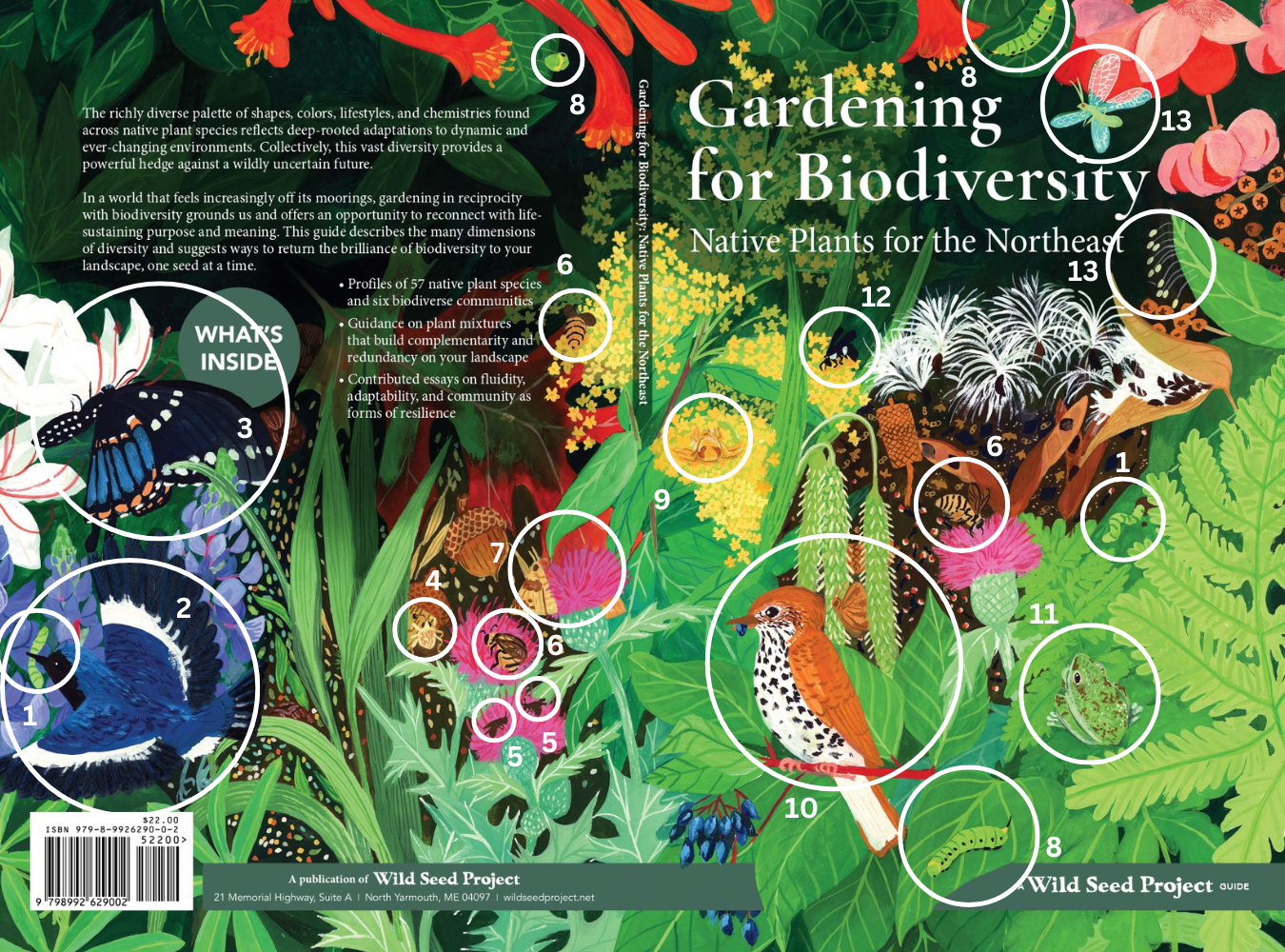
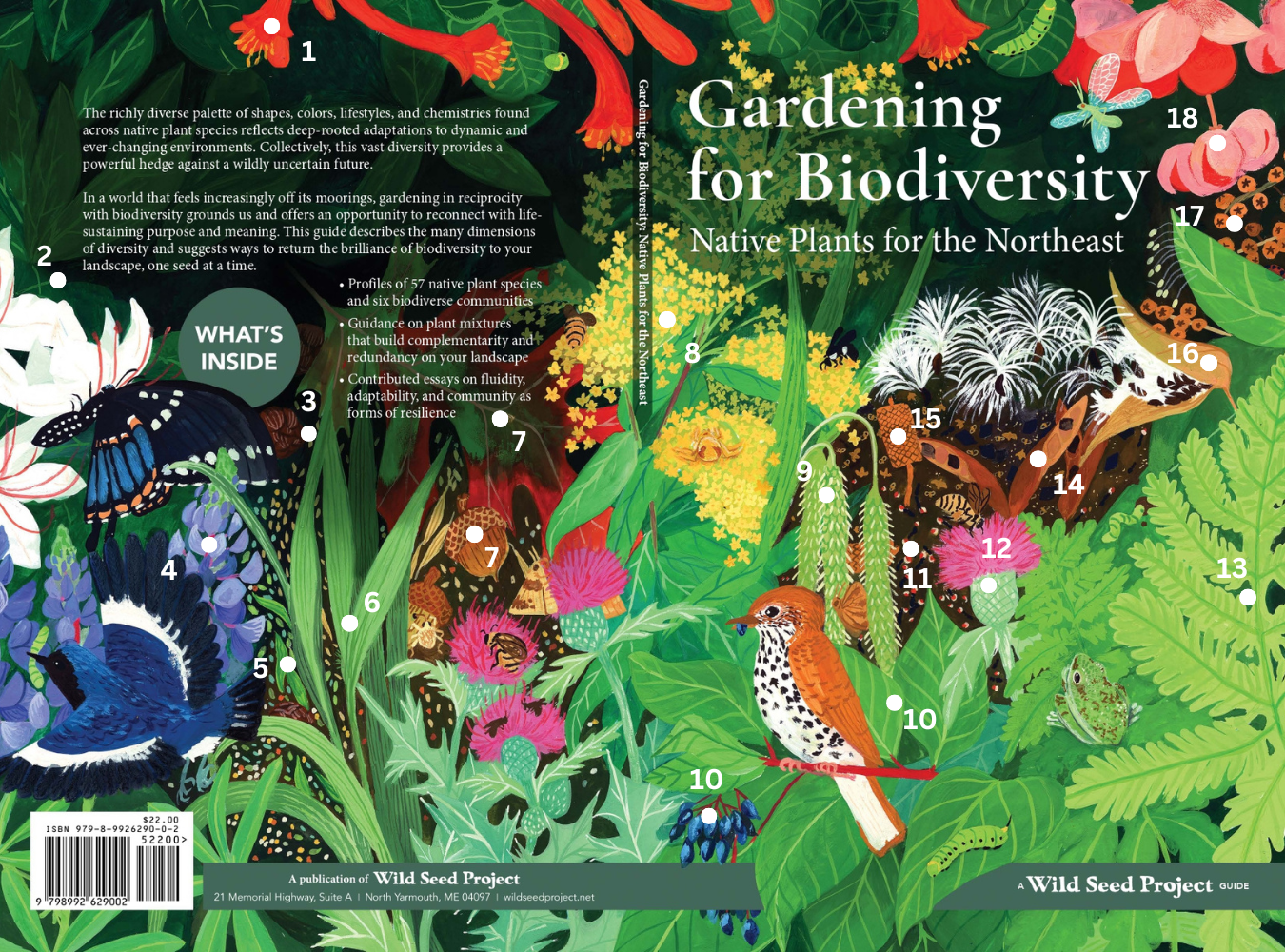
The cover illustrations for our newest guide, by Julian Plum, are dense with delights. We can’t stop looking at them, noticing more and more detail each time. So, we decided to make a game of it! Who do you spot hiding in the leaves?
Scroll to the bottom of the page for the answer key. Enjoy your exploring!
Animals
-
Acorn weevil / Curculio sp.
Black-throated blue warbler / Setophaga caerulescens
Carpenter bee / Ceratina sp.
Four-toothed mason wasp / Monobia quadridens
Golden northern bumble bee / Bombus fervidus
Goldenrod crab spider / Misumena vatia
Gray tree frog / Dryophytes versicolor
Inchworm / Geometridae sp.
Lacewing / Chrysopidae sp.
Snowberry clearwing / Hemaris diffinis
Spicebush swallowtail / Papilio troilus
Wood thrush / Hylocichla mustelina
Zabulon skipper / Lon zabulon
Plants
-
Bloodroot seeds / Sanguinaria canadensis
Broad beech fern / Phegopteris hexagonoptera
Eastern wahoo / Euonymus atropurpureus
Fringed sedge / Carex crinita
Gray birch cone / Betula populifolia
Jewelweed pods & seeds / Impatiens capensis
Licorice goldenrod / Solidago odora
Maleberry seeds / Lyonia ligustrina
Partridge pea pods & seeds / Chamaecrista fasciculata
Poke milkweed pods & seeds / Asclepias exaltata
Scarlet oak leaf & acorn / Quercus coccinea
Silky dogwood leaf & fruit / Swida amomum
Sundial lupine / Lupinus perennis
Swamp thistle / Cirsium muticum
Sweet azalea / Rhododendron arborescens
Switchgrass / Panicum virgatum
Tamarack cone / Larix laricina
Trumpet honeysuckle / Lonicera sempervirens
Answer Keys
-
Inchworm / Geometridae sp: Inchworms are caterpillars – the most essential food source for most baby birds. Adult birds may eat seeds or nuts or fruit, but nearly all terrestrial birds need succulent, densely nutritious caterpillars to make it out of the nest.
Black-throated blue warbler / Setophaga caerulescens: This migrating bird inhabits shrubs more than trees, and dines primarily on insects: caterpillars, moths, flies and spiders.
Spicebush swallowtail / Papilio troilus: The name says it: these lovely, spotted butterflies are spicebush specialists, and require spicebush (or sassafras) for their caterpillars. The adults’ feeding habits are a bit wider ranging, including jewelweed, Joe-pye weed, azalea and milkweed, but like many butterflies and moths, the young are picky eaters.
Acorn weevil / Curculio sp: These little beetles have a delightfully long snout, with which they drill their way into an acorn and deposit an egg. After hatching, the young larvae nibble the acorn inside out, until they finally climb out to overwinter in the leaf litter as grubs. There, they may become food for birds or small mammals, or make it to the adult stage to start the cycle again.
Carpenter bee / Ceratina sp: Small, dark, not fuzzy: you might not spot this as a bee at first glance. Ceratina comprise just some of the over 250 species of bee native to the Northeast, who show up in a dazzling array of colors, shapes and lifestyles. Ceratina’s lifestyle is to visit long-flowered plants for nectar and pollen, and bring these back to tiny nests hollowed out of pithy stems.
Zabulon skipper / Lon zabulon: Latin names don’t get much more fun to say than Lon zabulon. Caterpillars favor grasses, and adults seek nectar from milkweed, Joe-pye weed, buttonbush and thistle.
Golden northern bumble bee / Bombus fervidus: Bumblebee’s ability to buzz-pollinate, that is, shake pollen free of flowers by rapidly humming their wings - makes them vastly more effective pollinators of many important crops, including blueberries and potatoes (not to mention, lots of other native plants, too).
Snowberry clearwing / Hemaris diffinis: The adult form of this moth family is quite impressive: the nicknames “hummingbird clearwing” and “flying lobster” give a sense of what you might see visiting honeysuckle, bee balm and milkweed in the garden – so long as you leave leaf litter for the cocoons to overwinter. Come spring, they’ll emerge and grow into fat little green caterpillars on honeysuckle, bush honeysuckle, and snowberry.
Goldenrod crab spider / Misumena vatia: These spiders have also noticed that goldenrods are keystone species. They actively camouflage themselves by observing flower color and tinting themselves to match (like a chameleon, but slower). Once hidden, they can spring out to catch the array of visiting insects unawares.
Wood thrush / Hylocichla mustelina: The pretty, fluting song of wood thrushes may be heard where there is sufficient tree and shrub cover for them to nest, and sufficient leaf litter on the ground to rummage around for grubs and insects.
Gray tree frog / Dryophytes versicolor: These frogs emerge from hibernation in late April and May, when you may start to hear them calling in the evenings. Gray tree frogs require trees to live in, a pond to lay eggs, and plenty of bugs to eat.
Four-toothed mason wasp / Monobia quadridens: Wasps play an essential role as predators in the ecosystem: they are the tiny wolves to the caterpillars' tiny deer. Without wasps, we lose that balance – and as vegetable gardeners, we might lose more leaves to an overabundance of caterpillars. To make a welcoming home for mason wasps, provide hollow and pithy stemmed plants, much as you would for carpenter bees.
Lacewing / Chrysopidae sp: This family holds many species of delicate, dusk-flying pollinators. When in their larval form, they are “tiny alligators” in both appearance and appetite, happily eating up aphids, caterpillars and other soft-bodied bugs. And their eggs are something else again: teeny white pearls suspended on threadlike stalks on the underside of leaves.
-
Trumpet honeysuckle / Lonicera sempervirens: Red, tubular flower is perfect for hummingbirds (we have one species native to the Northeast), butterflies and other long-tongued insects. Songbirds, including purple finches, hermit thrushes, and catbirds, eat the berries.
Sweet azalea / Rhododendron arborescens: Cinnamon-scented flowers attract many bees, including the specialist azalea mining bee. Leaves feed caterpillars and deer.
Tamarack cone / Larix laricina: The larch. A deciduous conifer! This tree without flowers is a reminder of all the ways plants feed and house animals beyond nectar: the cones sustain red squirrels, red crossbills and pine siskins; leaves support Columbia silkmoth and Poecila sphinx moth, and the branches provide summer cover to song sparrows, common yellowthroats, and veeries.
Sundial lupine / Lupinus perennis: Host plant for the endangered Karner blue butterfly. Unlike the commonly seen (but non-native) big leaf lupine, sundial lupine is adapted to habitats that are now rare, due to destruction and fire suppression: sand barrens and oak-savannas.
Jewelweed pods & seeds / Impatiens capensis: One of the most delightfully tactile plants - When the pods are nearly ripe, the lightest touch will send them flying open to disperse seeds far and wide. Like trumpet honeysuckle, the long narrow flower holds nectar just for hummingbirds, butterflies and long-tongued bees.
Switchgrass / Panicum virgatum: Robust clumps of foliage provide essential winter cover for many kinds of wildlife. We might often first think of plants in terms of their value as food - nectar, fruits, seeds - but a place to shelter away from storms and predators is just as essential.
Scarlet oak leaf & acorn / Quercus coccinea: Oaks are a keystone species, with each tree capable of hosting hundreds of species of insects, birds, mammals and more. Leaves on the tree are food; leaves on the ground are overwintering bug homes. Branches hold nests, acorns feed squirrels - oaks are a very giving tree.
Licorice goldenrod / Solidago odora: Goldenrods are also keystone species, supporting about 150 bees, moths, butterflies and others. Nectar from late-flowering goldenrod fattens up migrating monarchs and bumble bees preparing for the winter, while the leaves feed dozens of hungry caterpillars.
Fringed sedge / Carex crinita: Many different insect species feast on sedges: satyrid butterflies, skippers, owlet moths, grasshoppers, meadow katydids, reed beetles and billbug weevils.
Silky dogwood leaf & fruit / Swida amomum: Flat-topped clusters of flowers attract beetles, butterflies, wasps, bumblebees and specialist dogwood mining bees. Juicy fruits feed migrating birds, wild turkeys, small mammals and turtles.
Bloodroot seeds / Sanguinaria canadensis: The tiny white crescents are “elaiosomes” - densely nutritious little packets that ants nibble after hauling the seeds back to their nests. Baby ants get fed, bloodroot gets dispersed.
Swamp thistle / Cirsium muticum: Like other members of the sunflower family, thistle flower heads are dense with nectar-bearing florets. The vibrant flowers feed monarchs, swallowtails, fritillaries, bumblebees and the thistle long-horned bee. When it goes to seed, goldfinches, juncos, sparrows and indigo buntings come to feast.
Broad beech fern / Phegopteris hexagonoptera: Happy to grow in deep shade, this fern spreads to create a ground cover that provides cover to amphibians, insects and small mammals.
Partridge pea pods & seeds / Chamaecrista fasciculata: Partridge pea feeds bobwhites, mallards and small mammals. When in flower, many bee species visit, and ants ward off predators in return for sweet juice from extrafloral nectaries. Seed pods spring open when ripe, in the same delightfully ballistic manner as jewelweed.
Gray birch cone / Betula populifolia: Densely packed with tiny winged seeds that disperse on the wind - sometimes you’ll find them sitting atop snow drifts in winter. The seeds feed songbirds, sapsuckers drink the sap and grouse eat catkins and buds. The trees provide habitat to hares and bobcats.
Poke milkweed pods & seeds / Asclepias exaltata: Less known, this milkweed thrives in shade and the leaves support caterpillars of monarchs and milkweed tussock moth. Early blooming for a milkweed (late spring to early summer), the flowers provide nectar when many others are not.
Maleberry seeds / Lyonia ligustrina: The flowers of this shrub resemble their cousin, blueberries, and support specialist maleberry mining bees and blunt-horned bees. While keystone species like asters and goldenrods feed an array of pollinators, some pollinators have evolved relationships with only one or a few plants. A diverse ecosystem includes both.
Eastern wahoo / Euonymus atropurpureus: Leaves and fruits arrive with magnificent fall color like its cousin burning bush - but having grown up in this ecosystem, it stays happily in balance with others.