
One City Center
Downtown Portland, Maine
A public ecological garden with rich layers of native trees, shrubs, ferns, and wildflowers buffer noise, provide cooling shade, and withstand climate extremes, while also safeguarding critical habitat for bees, butterflies, moths, and birds in an urban environment.
Garden design by Heather McCargo
for Wild Seed Project
Situated near the Atlantic Ocean in downtown Portland, Maine, this site experiences several extremes. The sunny space has fast-draining, sandy soil prone to drought, which is compounded by the urban heat island effect: the city’s high impervious cover keeps it around 6°F warmer than the neighboring countryside. Plants here must also withstand temperamental ocean winds and heavy road salt applied over long Maine winters.
Site Conditions
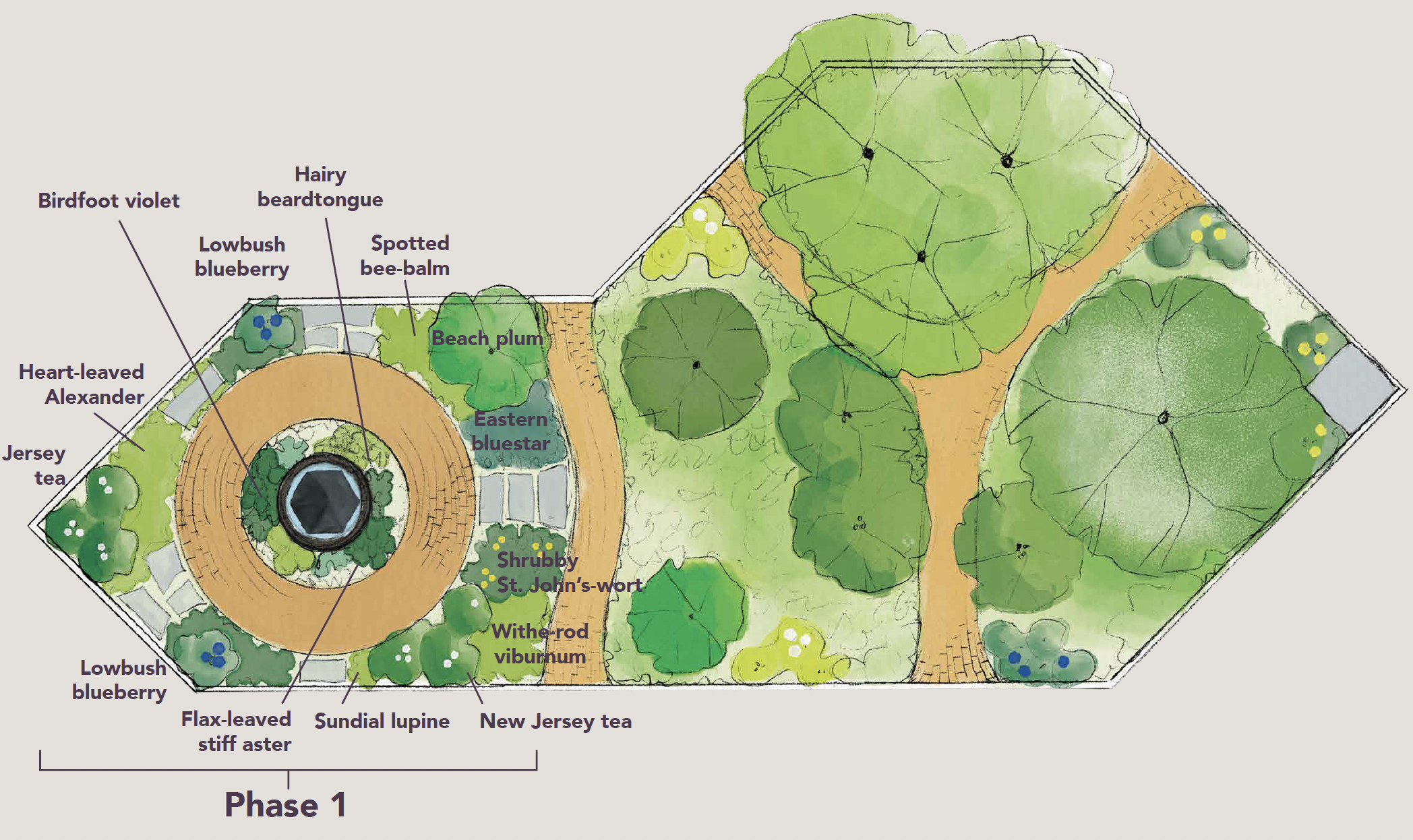
Design Plan: Phase 1
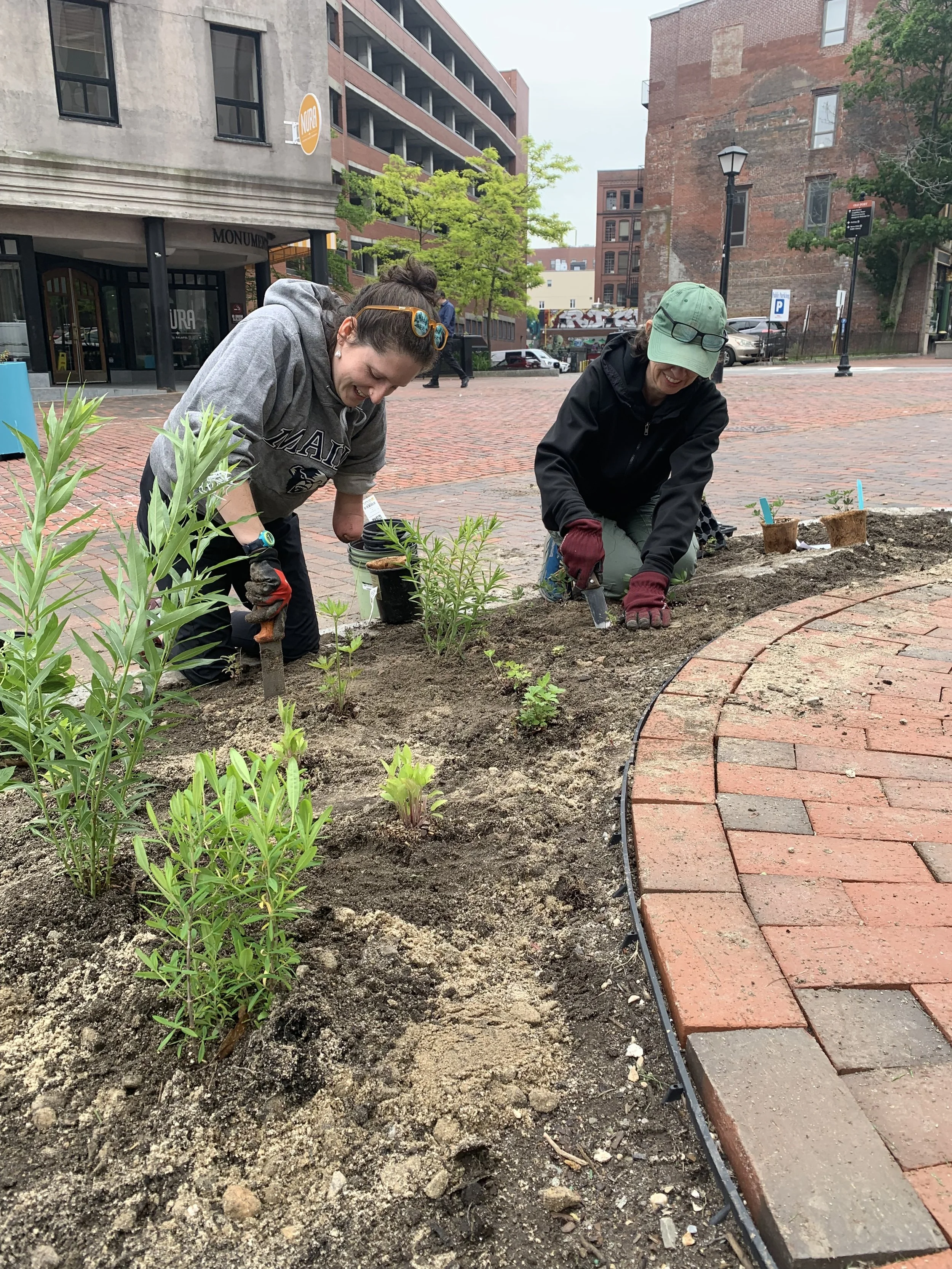
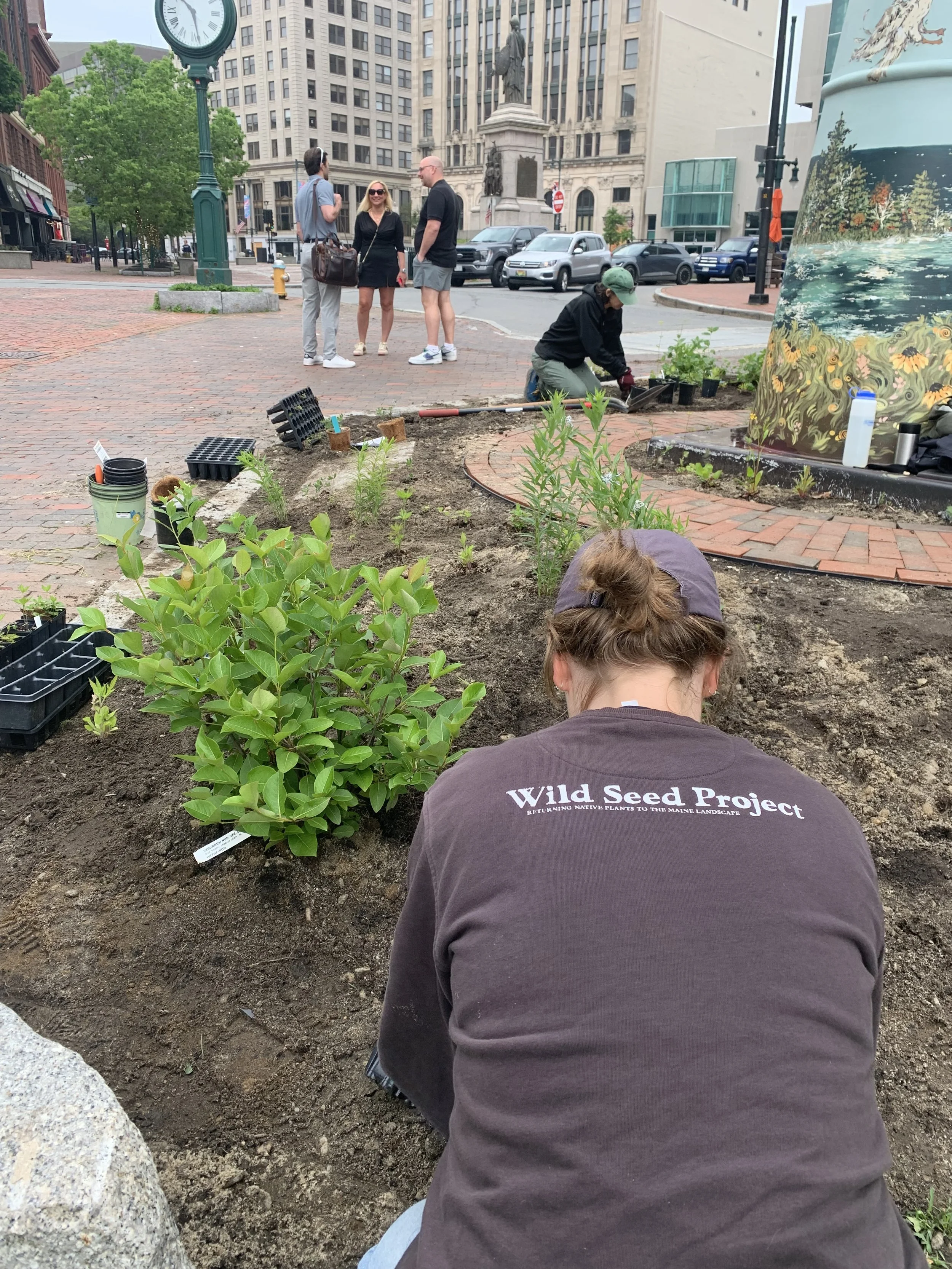
The northwest area of the garden is planted with a mix of low-growing herbaceous species, along with a few shrubs and small flowering trees. This combination of native plants is well-suited to hellstrips—the narrow, often-neglected strips of land squeezed between sidewalks, streets, and parking lots.

Species List: Phase 1
Download:
Complete species list (spreadsheet)
Wildflowers
Three-lobed rudbeckia (Rudbeckia triloba)
Foxglove beardtongue (Penstemon digitalis)
Bluestar (Amsonia tabernaemontana)
Tall anemone (Anemone virginiana)
Butterfly milkweed (Asclepias tuberosa)
Sundial lupine (Lupinus perennis spp. perennis)
Heart-leaved Alexander (Zizia aptera)
Spotted bee-balm (Monarda punctata)
Seaside goldenrod (Solidago sempervirens)
Partridge pea (Chamaecrista fasciculata)
Black-eyed rudbeckia (Rudbeckia hirta)
Gray goldenrod (Solidago nemoralis)
Bradbury bee-balm (Monarda bradburiana)
Flax-leaved stiff aster (Ionactis linariifolia)
Hairy beardtongue (Penstemon hirsutus)
Harebell (Campanula rotundifolia)
Birdfoot violet (Viola pedata)
Shrubs
Withe-rod viburnum (Viburnum nudum var. cassinoides)
Shrubby St. John’s-wort (Hypericum prolificum)
New Jersey tea (Ceanothus americanus)
Lowbush blueberry (Vaccinium angustifolium)
Trees
Beach plum (Prunus maritima)
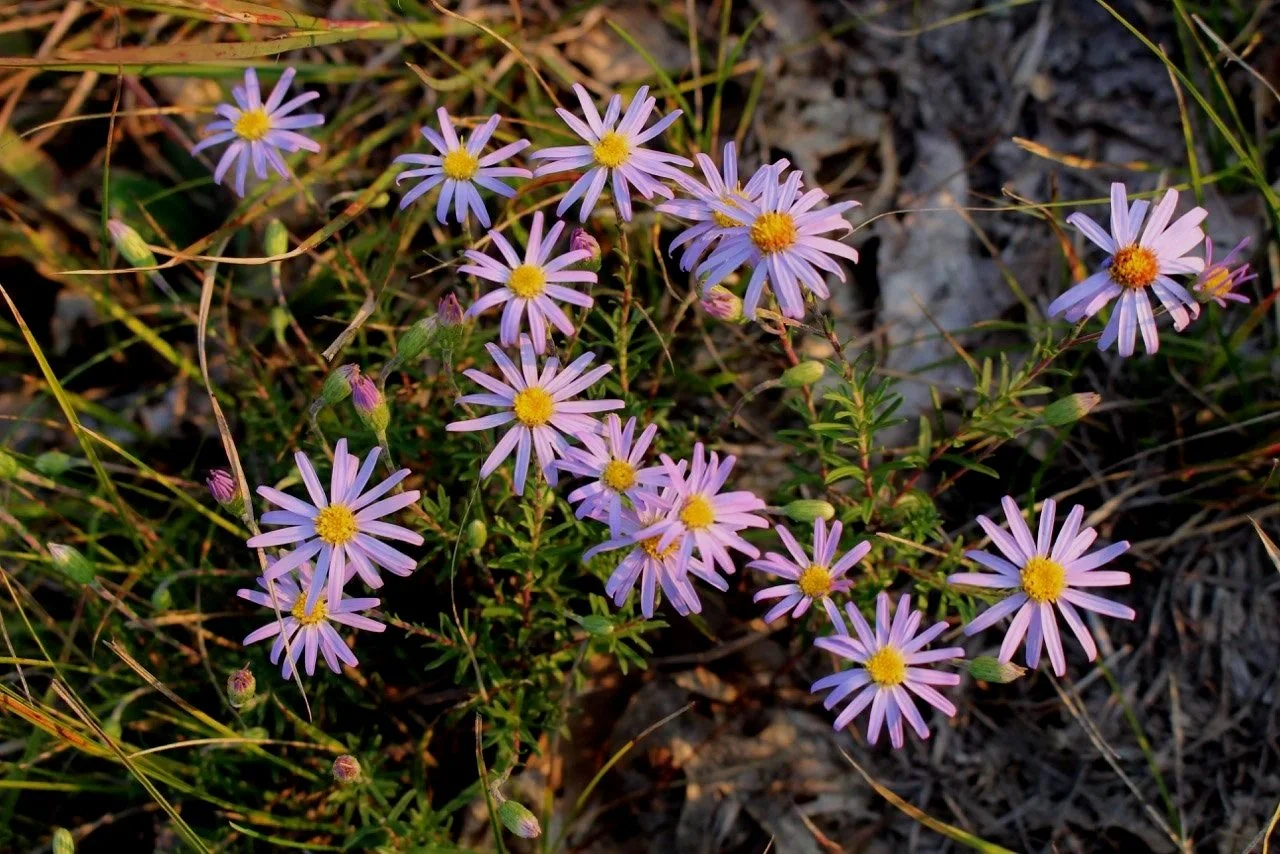
Flax-leaved stiff aster
Ionactis linariifolia
A diminutive aster for sunny, dry gardens, patio edges, or sandy/gravelly meadows. Small, dark green, needle-like foliage is covered with lavender blue flowers in late summer and early fall. Butterflies and bees visit the blossoms.

New Jersey tea
Ceanothus americanus
A low-growing, summer-blooming native shrub with abundant clusters of small white flowers that attract numerous butterflies, hummingbirds, and other pollinators. Excellent for hot, dry sites. Deer-resistant foliage.
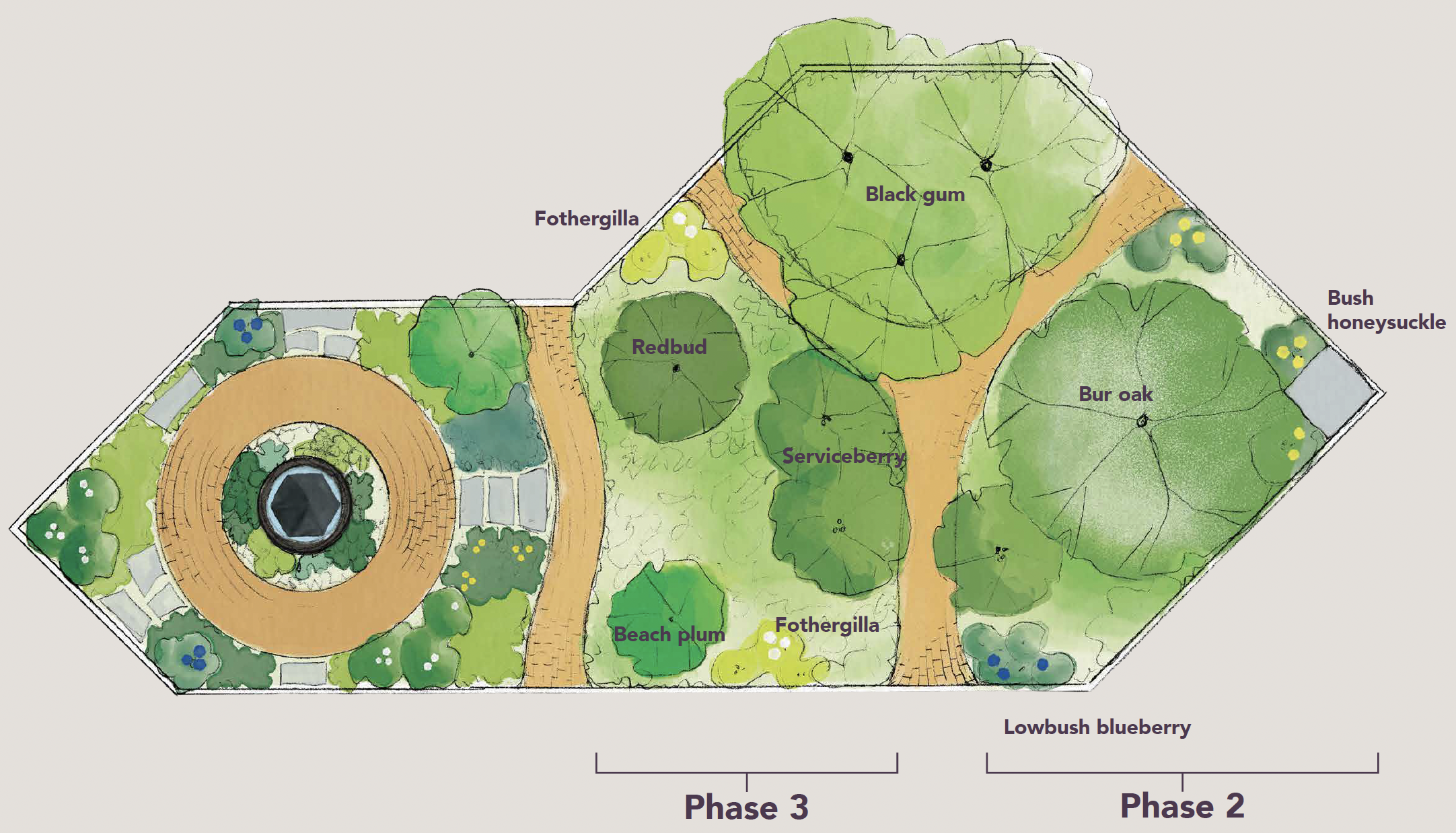
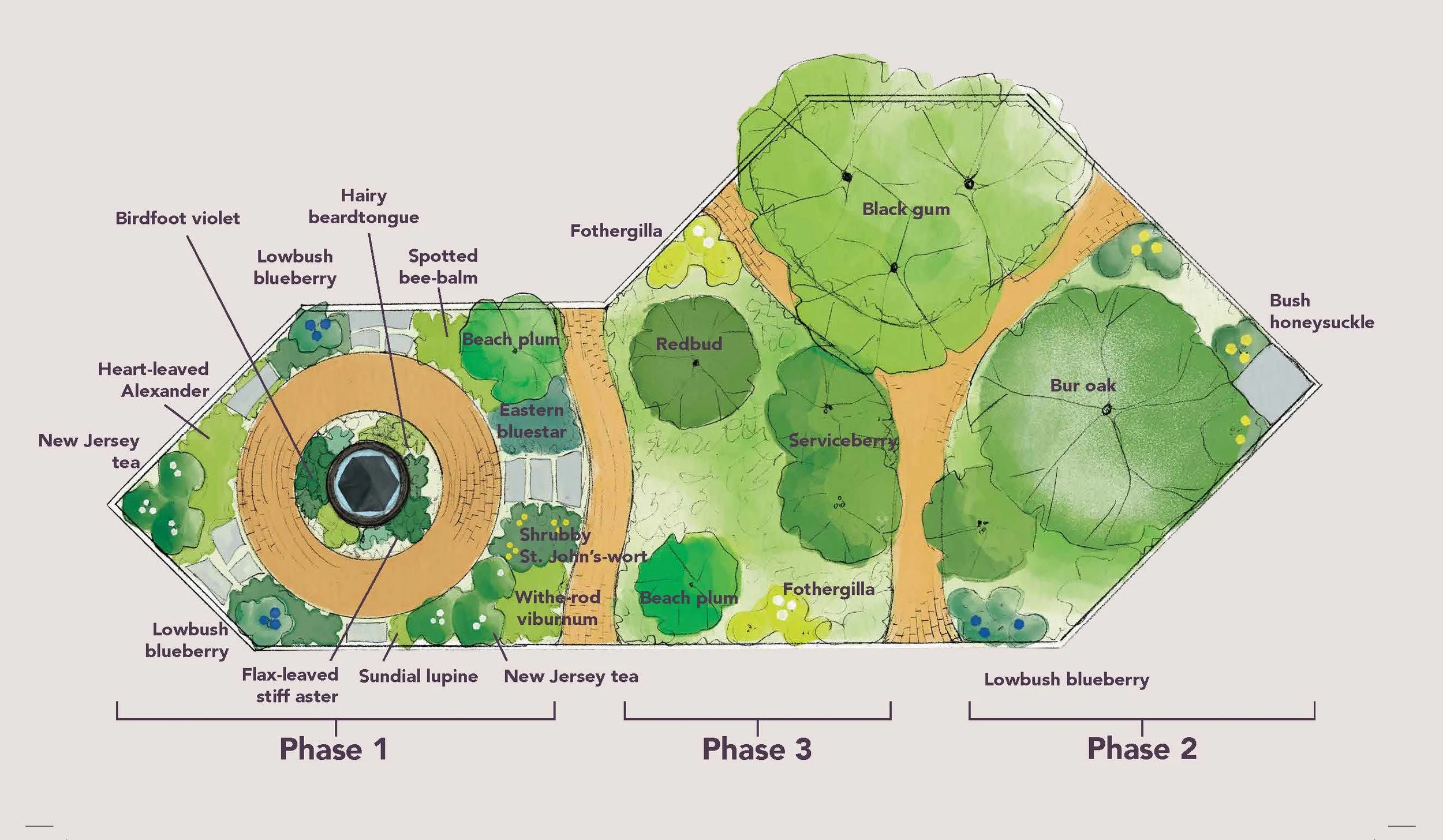
Design Plan: Phase 2 & 3
Installation forthcoming
On the southeast side of the site, shade trees offer a welcome relief from the heat, for people and wildlife alike. The cooler, shadier conditions allow many native woodland species to take root.
Note: design map shows placement of woody shrubs and trees only, not all herbaceous perennials.
Species List: Phase 2 & 3
Wildflowers
New England aster (Symphyotrichum novae-angliae)
Blue-stem goldenrod (Solidago caesia)
Blue lobelia (Lobelia siphilitica)
Blue wood aster (Symphyotrichum cordifolium)
Golden Alexander(Zizia aurea)
Zigzag goldenrod (Solidago flexicaulis)
White wood aster (Eurybia divaricata)
Red columbine (Aquilegia canadensis)
Golden groundsel (Packera aurea)
Jacob's ladder (Polemonium reptans)
Wild geranium (Geranium maculatum)
Common self-heal (Prunella vulgaris ssp. lanceolata)
Wild ginger (Asarum canadense)
Ferns
Christmas fern (Polystichum acrostichoides)
Shrubs
Fothergilla (Fothergilla gardenii)
Bush honeysuckle (Diervilla lonicera)
Trees
Bur oak (Quercus macrocarpa)
Black gum (Nyssa sylvatica)
Redbud (Cercis canadensis)
Canada serviceberry (Amelanchier canadensis)
Download:
Complete species list (spreadsheet)

Beach plum
Prunus maritima
Beach plums grow in coastal sand dunes from the mid-Atlantic to the Canadian Maritimes. Tolerant of salt and drought, they thrive in seaside gardens and can withstand hot, dry urban areas. People and wildlife alike delight in the tart, cherry-sized purple fruits that typically ripen in September. To ensure fruit set, plant at least two beach plums.
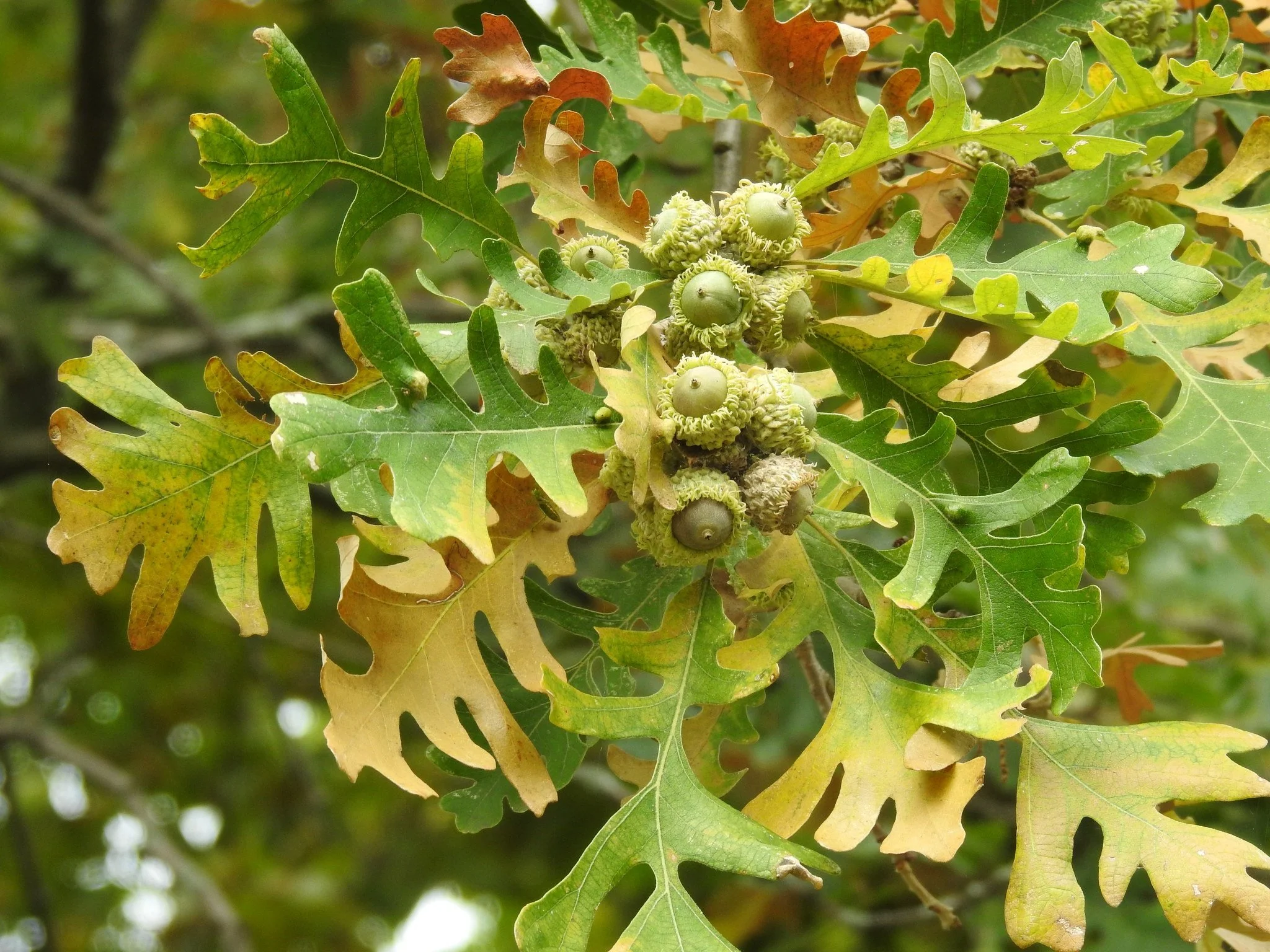
Bur oak
Quercus macrocarpa
Bur oak is a stunning shade tree that develops a broad canopy adorned with the largest acorns of any native oak. Highly adaptable to a range of conditions, mature trees can withstand flooding and drought. As keystone species, native oaks support nearly 500 species of moths and butterflies, including the giant leopard moth, and provide excellent nesting sites for songbirds.