
In the Shade: Gardening with Native Plants from the Woodland Understory
by Heather McCargo
Many beautiful and resilient plants from the woodland understory of eastern North America can be planted in shady places at home. There are woody and herbaceous species with delicate blossoms, an array of fruits and seeds, a variety of leaf shapes and colors, and interesting bark or branching patterns. Shady landscapes are easy to care for since they require minimal weeding and watering, and they support a host of interesting woodland birds, pollinating insects and small animals. As our climate continues to warm, cool shade is something that we will all be needing more of in the coming years.


Clockwise from top left: Bottle gentian, Golden groundsel, Blueberry, Spotted crane’s-bill
Every human inhabited landscape has at least some shade due to the structures around us. Even on a treeless lot, the north, east, and west sides of buildings are without direct sunlight all or part of the day. These overlooked environments in our developed landscapes provide a great opportunity to increase the diversity of woodland flora.


Clockwise from top left: Bellwort, Redbud, Yellow violet, Wood phlox, Witch-hazel, Baneberry
Cool it Down
Trees are key players in moderating the global climate. Trees reduce surface temperatures by shading the understory, deflecting radiation from the sun, and cooling the air through the release of water from their leaves. Trees remove carbon dioxide from the atmosphere and store it in their woody tissue and in return give us oxygen to breathe. They capture rainwater and help it absorb into the soil, reducing flooding. Native trees are biodiversity magnets because they host a variety of fauna in their canopy, bark and roots.
Shade Loving Plants
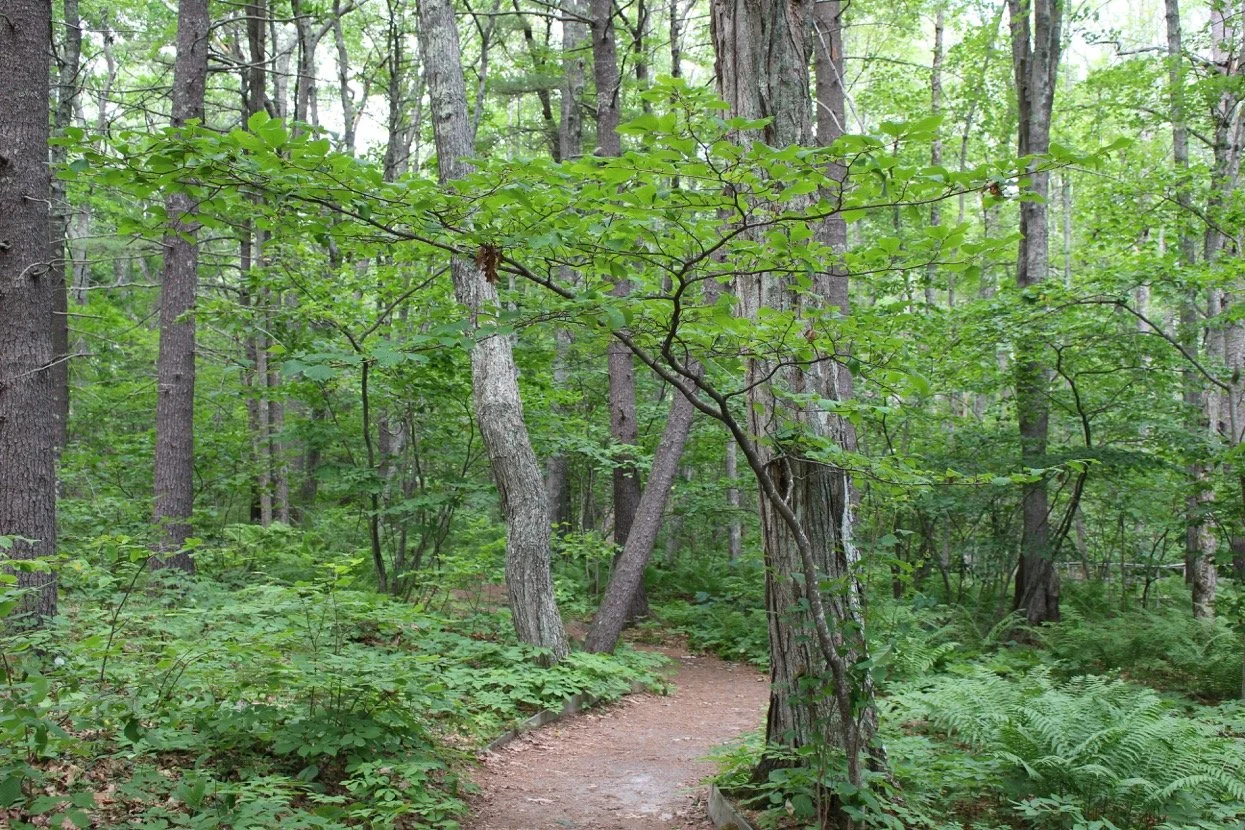
The Eastern deciduous forest biome that stretches from Canada to Georgia is the world’s richest temperate woodland ecosystem with a diverse mix of plants that thrive in the shade of the canopy trees. Maine is part of the transition zone between the Eastern deciduous forest to the South and the boreal forest to the North. Canopy trees include deciduous oak, maple, birch, beech, bass, and ash, and coniferous evergreens of hemlock, spruce, fir and pines. The ground layer of the woodland understory holds most botanical biodiversity. Wildflowers, ferns, small shrubs, understory trees and juvenile canopy trees all make a rich tapestry that is beautiful as well as biologically dynamic. Many of these plants are easy to grow and will thrive in shady locations in our urban and suburban landscapes.
Planting a Shady Area
1. Assess Light Levels
Thinking about how the plants of the forest have adapted to life in the shade will help you choose how to include them in your landscape. Plants that grow under deciduous trees receive more direct and indirect sunlight than plants growing on north facing slopes or under evergreen trees. From the time they lose their leaves in the fall through mid to late spring when the trees leaf out, deciduous trees let light through to the forest floor. Many woodland wildflowers bloom in the spring to take advantage of this early season light. Other understory plants manage to capture enough light even in locations with no direct sunlight. These are the plants that can tolerate the immediate north side of a building which is usually in complete shade. Farther out, the light levels can increase depending on the time of year. Adding small to medium sized deciduous trees in this zone will add dappled shade in which these woodland plants thrive and will prevent them from being scorched during the height of the summer sun.
2. Add Multiple Layers of Vegetation
Creating layers of vegetation with understory trees and large shrubs is an important element of shade planting. These layers provide habitat for birds and pollinators, which in turn makes a much more visually interesting landscape than just planting the ground level. For detailed explanations and photos of this concept read The Living Landscape by Rick Dark and Doug Tallamy.
3. Mimicking Woodland Soils
The nature of the woodland soil is another important component when creating a shaded habitat. Every year, the leaves of deciduous trees, shrubs and wildflowers die and return to the soil to decay and provide nutrients and insulation to the soil and its diversity of life (e.g., fungi, microorganisms, insects and small animals). You can mimic this in your shady landscape by adding plenty of organic matter in the form of compost, leaf mold, or very well aged natural hardwood bark. If the existing soil is compacted from construction or foot traffic, it can be loosed with a digging fork. You are not trying to turn the soil over, just loosen the compacted soil while being careful of existing tree roots. In the fall, when the new crop of leaves falls on your beds, leave them. The leaf litter will improve the soil and provide overwintering habitat for many beneficial creatures such as butterflies, moths, frogs, salamanders and ground nesting birds.
Species by Shade Type:
Full Shade
Small to midsize trees and shrubs
Goosefoot (Striped) maple Acer pensylvanicum
American Hornbeam Carpinus caroliniana
Bush-honeysuckle Diervilla lonicera
Witch-hazel Hamamelis virginiana
Spicebush Lindera benzoin
American honeysuckle Lonicera canadensis
Viburnums Viburnum acerfolium, V. lantanoides
Blueberry Vaccinium angustifolium, V. coryumbosum
Perennials
Baneberries Actaea rubra, A. pachypoda
Black bugbane (cohosh) Actaea racemosa*
White snakeroot Ageratina altissimo
Wild ginger Asarum canadense
Jack-in-the-pulpit Arisaema triphyllum
Wood asters Eurybia divaricata, Symphyotichum cordifolia
Blue lobelia Lobelia siphilitica
False Solomon’s Seal Maianthemum racemosum (syn. Smilacina racemosa)
Solomon’s seal Polygonatum biflorum
Golden groundsel Packera aurea
Bloodroot Sanguinaria canadensis
Foam-flower Tiarella cordifolia
Violets Viola species
Ferns
Christmas fern, New York Fern, Lady Fern, Maidenhair Fern, Royal fern
Partial Shade, in addition to the species above
Small trees and shrubs
Shadberry Amelanchier canadensis, A. laevis
Alternate-leaved(Pagoda) dogwood Swida alternifolia (formerly Cornus)
Big-bracted-dogwood Benthamidia florida (formerly Cornus)
Hazelnut Corylus Americana, C. cornuta
Redbud Cercis canadensis*
Sweet-pepperbush Clethra alnifolia
Mountain laurel Kalmia latifolia
Rhododendron Rhododendron maximum
Azaleas Rhododendron prinophyllum, R.viscosum
Red elderberry Sambucus racemosa
Perennials
Red Columbine Aquilegia canadensis
Tall bellflower Campanula Americana*
Bleeding heart Dicentra eximia *
Eastern shooting star Dodecatheon meadia *
Spotted crane’s-bill Geranium maculatum
Bottle gentians Gentiana andrewsii, G. clausa
Wood phlox Phlox divaricata, P. stolonifera *
Jacobs-ladder Polemonium reptans *
Woodland goldenrods Solidago caesia, S. flexicaulis
Bellwort Uvularia grandiflora*
Ground Covers vs. Garden Plantings
If you are looking for very low maintenance ground covers instead of a shady garden with distinct individuals and clusters of plants at the ground layer, combine at least 2-3 species to create a beautiful tapestry of foliage and blooms with woody shrubs and trees growing through. These plants are low growers and make a dense covering that will crowd out weeds once established:
Canada anemone Anemone canadensis
Large-leaved wood aster Eurybia macrophyllus
Hay-scented fern Dennstaetdia punctilobula
May-apple Podophyllum peltatum*
*These species are native to eastern North America but not the state of Maine
Planting Under and Around Conifers
Conifers can be more challenging to plant around because of their acidic needle drop and because they tend to have many surface roots that compete for water and nutrients. Thinning the canopy can help to let more light in to support more understory plants.
Woody trees and shrubs
Maples Acer pensylvanicum, A. spicatum
Shadberry Amelanchier canadensis, A. laevis
Bush-honeysuckle Diervilla lonicera
Witch-hazel Hamamelis virginiana
Black Huckleberry Gaylussacia baccata
American honeysuckle Lonicera canadensis
Red Elder Sambucus pubens
Viburnums Viburnum acerfolium, V. lantanoides
Blueberry Vaccinium angustifolium, V. coryumbosum
Wild Raison Viburnum nudum sp. cassinoides
Perennials
Wild sarsaparilla Aralia nudicaulis
Bunchberry Chamaepericlymenum canadense
Wild Strawberry Fragaria virginiana
Wintergreen Gaultheria procumbens
False Solomon’s Seal Maianthemum racemosum (syn. Smilacina racemosa)
Sessile-leaved bellwort Uvullaria sessifolia
Violets Viola species
NOTE: Many woodland wildflowers in nurseries, including trilliums, Dutchman’s breeches, lady’s-slipper orchids, ferns and others, are poached from the wild. Please do not purchase wild collected native plants, and only purchase nursery-propagated plants. See blog post Where the Wild Things Are: Pink Lady Slipper Orchids and Poachers.